
How to get Britain behind Burnham’s new vision?
Britons want change, but they need a story that makes sense of it. Will Snell, Fairness Foundation, sets out the conception of fairness that can hold the country together.
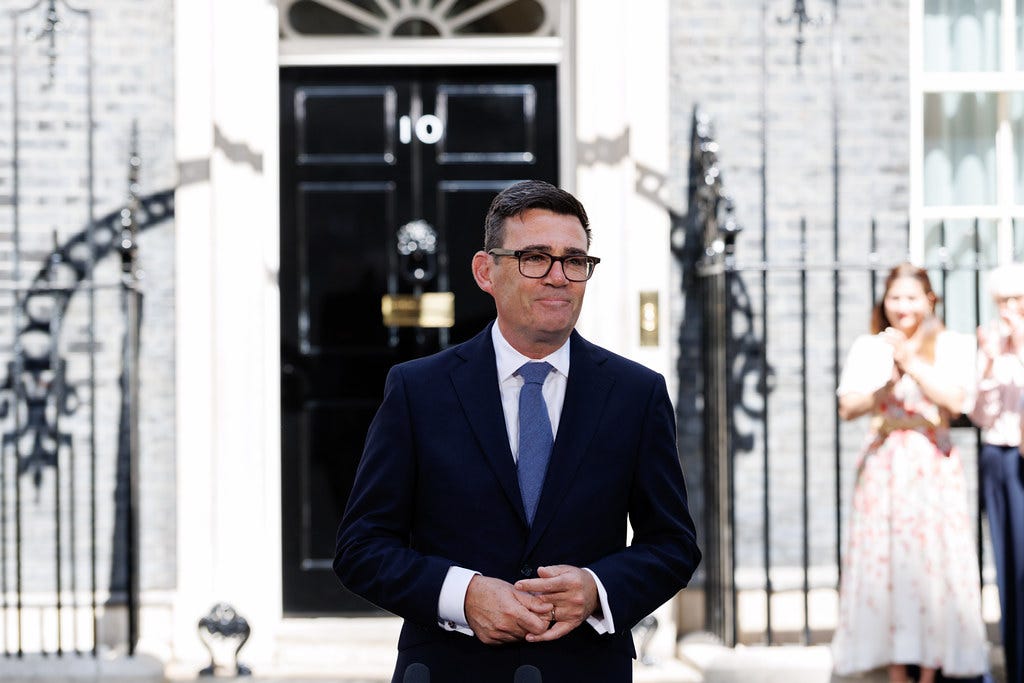
Andy Burnham used his lectern-free new-PM speech in Downing Street on Monday to promise “a circuit breaker for Britain, bringing forward the biggest changes in the last forty years; a new political model and a new economic model”. He named the wrong turns of the 1980s directly: “political power… centralised, economic power privatised, large parts of the country de-industrialised”. Three days earlier, at the Trades Union Congress for his coronation as Labour leader, he spoke of the essentials - housing, water, energy, transport – having been surrendered to private hands, concentrating “wealth and power in the hands of fewer people and fewer places”. And he promised to push power out to “every postcode” and to take the essentials back into public control as well as taking immediate action to tackle the cost of living (beginning on Tuesday, with a VAT cut on energy bills to give people “some breathing space”).
The vision is bold, and well described – and we’ve been sorely lacking in political vision of late. Of course, everyone is rightly pointing out that the hard part is turning words into action. What makes this difficult is partly about choosing what to do, partly about finding a way to do it effectively (including working out how to fund it), and partly about bringing the country with you. It’s the last of those three that I want to focus on in this post.
Vision only gets you so far
The new PM doesn’t have much hope of persuading the British public to support his policy programme, whatever it ends up looking like, if he hasn’t first sold them on the underlying vision, on both the diagnosis of what is wrong today and the principles of what he wants to build tomorrow. He has set out both eloquently, albeit with little detail. But getting people to buy into this vision is not easy given that, as Burnham himself admits, “people at home are fed up with politics.” The problem is not that the public doesn’t want change, but that people have stopped believing that change is possible. His plea that this be “the moment when Britain starts to believe again” is the right ambition, but the question is how to rekindle that belief.
The starting point is to look for opportunities to build a consensus of concern about the status quo and of appetite for changing it. And I believe that inequality is one of the best of those opportunities. Although we’re divided in some respects, the British public is pretty united on this issue; our polling with Ipsos found that 85% of Britons are worried about inequality. This is not a fringe concern or a metropolitan preoccupation, but a super-majority of concern stretching across every region, class and voting bloc.
That concern doesn’t automatically translate into support for specific solutions, however. Roughly three in four people think the gap between rich and poor is too wide, but only a small majority think the government should redistribute more to close the gap. This discrepancy is driven by many factors, not least a growing mistrust that government will spend the money well. But politicians must lead from the front, not be slaves to polling or focus groups, and there’s an opportunity for Burnham to win the argument for stronger action to tackle inequality – including but not only through the tax system – in the face of public ambivalence about specific policy solutions. The right has long understood that you change the political weather by deciding which issues matter.
Fairness, properly defined
How you define and describe the issue is key, too – and here the stale debate between ‘equality of outcome’ and ‘equality of opportunity’ comes into play, yet again. To frame the issue as being around ‘fairness’ rather than ‘equality’ sounds like a deliberate fudge, a vanilla cop-out. But if fairness is clearly defined, it is a much more useful concept. We distinguish between five mutually supportive aspects of fairness, what we call the ‘fair necessities’ – fair essentials, fair opportunities, fair rewards, fair exchange and fair treatment. Did people get a fair shot? Were they rewarded for what they put in? Were they treated with respect? Defined in this way, fairness enjoys majority support even among people on the right of politics.
Most Britons are ‘fair opportunists’: they think about fairness as everyone having a fair chance, not everyone ending up in the same place, but they are also sensitive to the argument that fair opportunities cannot exist in a country of very unequal outcomes. Pitch reform as levelling the playing field and rewarding contribution, and the country listens. Pitch it as flattening the gap for its own sake, and half the country stops listening. But there is still strong support for the idea that everyone should be able to afford the essentials – whether that is achieved by cutting VAT on energy bills or other means.
Universal policies tend to generate public support, because they avoid framing public spending as being for other people. The best way to build support for big policy reforms - around council homes, support for young people, the preventative state that “invests in people’s success rather than paying for failure” – is to make the argument in terms of reciprocity. We all contribute to society, in some way or another, over the course of our lives, and we should all be supported by it in return when we need that support. There is no need to try to frame these interventions as trying to solve other people’s problems; these problems affect all of us, directly and indirectly. Even the pledge to end rough sleeping is better set out as a minimum provision of essentials than as charity. As Burnham put it, it is about “the right values and the right standards at the heart of government”.
Predators and producers, again
None of this means that we have to pretend that everyone is on the same side. The public dislikes bashing the rich; most people aspire to wealth and see it as a form of security in an insecure world. However, they support action when wealth is seen as being unearned, or when the wealthy behave badly by dodging tax, buying influence, paying poverty wages or profiteering. The distinction that matters is not between the wealthy and the rest of us so much as between those who extract wealth and exploit workers and those who create jobs and rebuild the country. Ed Miliband tried to distinguish between ‘predators and producers’ over a decade ago, but didn’t quite land the argument; Burnham has the chance to succeed where his Cabinet colleague failed.
Burnham has said that “change starts with honesty”, admitting that his own generation of politicians “failed to challenge… an economic model that simply doesn’t work well enough for ordinary people”. And that honesty is about to get tested. On wealth, Britain is split down the middle between those who have gained from decades of rising asset prices and those who have been locked out. Real change will ask something of far more people than the top 1%, and a government serious about carrying the country with it has to say as much, by starting an honest conversation about wealth that acknowledges that millions of comfortable Britons benefit from the status quo even if they don’t feel wealthy, instead of talking past that divide as governments have for years.
The new PM has a political vision that has the potential to transform Britain. What he needs now to help him to deliver on this in practice is the nerve to make the argument, and the honesty to admit what it will cost (Blair was good on both of these, even if he didn’t always get the diagnosis right). Burnham wants people “to say once again that Labour are for us”. A nuanced but concrete way of thinking and talking about fairness would help him to deliver on this promise in a way that brings the country with him.
Will Snell’s book, The Fair Necessities: Why We Need a Fairer Britain and How to Make It Happen, is out on 8 September with Policy Press. Get 25% off before midnight on Friday 24 July by pre-ordering at Waterstones with code SUMMER26. The launch event is on 8 September at King’s College London (register in person or online).
Recommended long read: An Honest Day, by Mark McVitie of the erstwhile Labour Growth Group
Recommended podcast: Antisocial Economics (a podcast series hosted by Dr Sarah Kerr)