
Securing change
The politics of hope, immigration, and much more

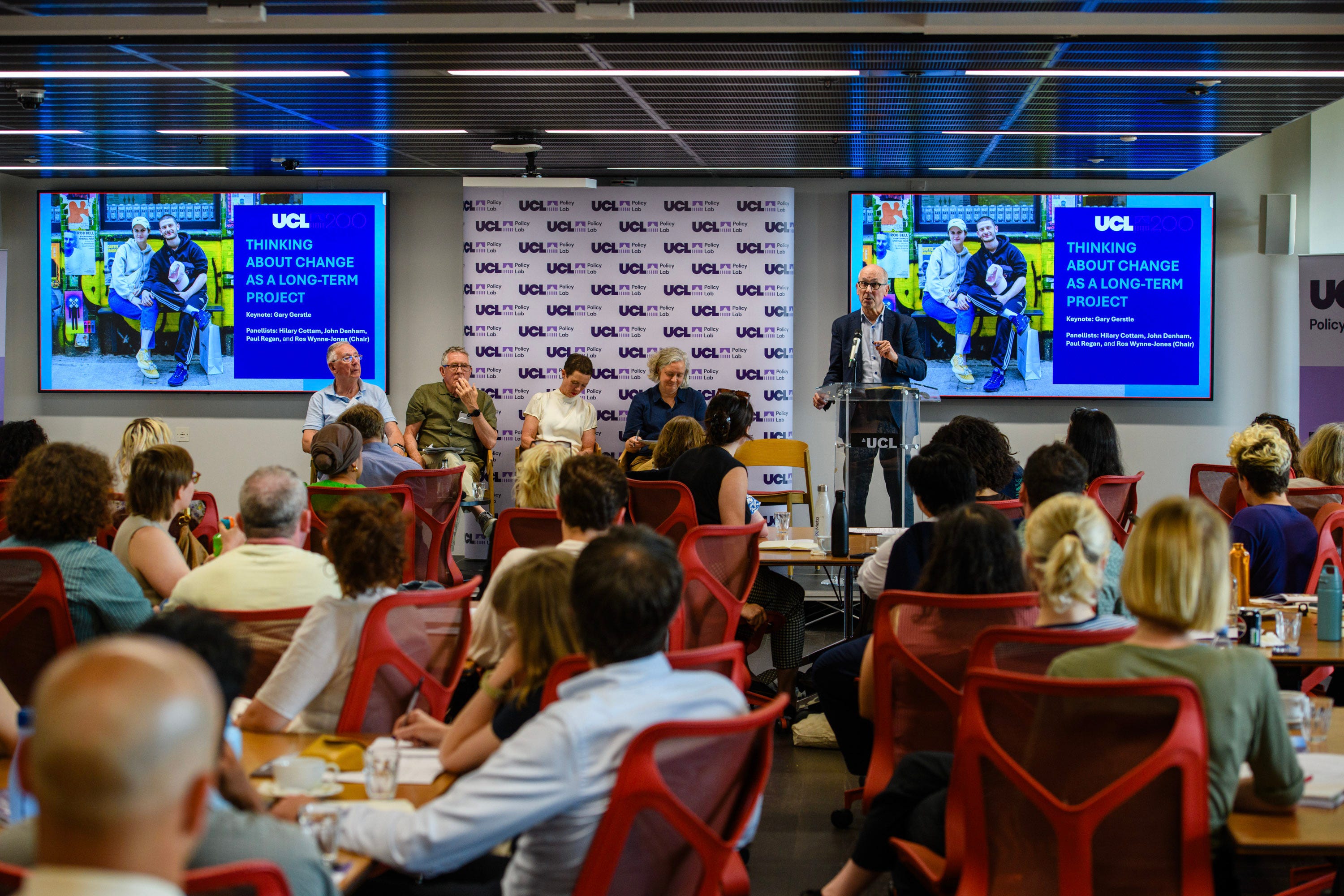
Last week, UCL Policy Lab hosted a conference that brought together an inspiring range of voices, from politicians and historians to community organisers, rabbis and priests. In the #4 Progressive Reader, HopeWorks reports back on the highlights of the event and the ideas it generated, with more to read to keep the conversation going.
The broken deal
Miatta Fahnbulleh MP, opened the event with her diagnosis of the ‘insurmountable’ challenges facing Britain. From 1 in 3 families struggling to get by, to the high percentage of children in poverty, she said “the public feel much has been promised, not enough has been delivered”. From all the "hundreds and hundreds of conversations”, she feels that “people are impatient for change, they are tired, frustrated”.
The scale of that broken deal was again made clear by a Social Market Foundation report. It lays out the challenge of food security and urges the government to deploy a whole-government approach to address the underlying drivers of poverty and food insecurity:
Family food insecurity in the UK is concerningly high. Over the past 12 months, 15% of parents reported not having enough food at some point, including 4% going without regularly.
Children are being directly impacted. 1 in 5 parents (21%) said their children are being affected by food insecurity– defined here as experiencing either a lack of food for their children, being unable to provide them with a balanced meal, or relying on a few low-cost foods for their children “always” or “often”.
Child food insecurity varies sharply across regions, household types, and family size – with levels the highest in London (27%), the North West (22%) and Wales (22%), compared to 21% nationally.
But the Labour MP did not shy away from offering solutions. She said we need to “offer a politics of hope that draws on the politics of cooperation” and that we must pursue a “new economic model that works for the majority of people”. “The thing that gives me hope – growing movement that believes in the ability of community power to drive change”.
She said this requires national policy change, but also action at the local level. “Radical and rapid devolution of power to local government and communities” is needed to give people a stake in the local economy. Only by putting communities in the driving seat can change be secured. If we put communities in charge, that is the way to grow the economy. She suggested Labour has already been delivering on this agenda, recalling her time on the front bench, and adding that “Piloting Pride in Place is the government policy I’m most proud of”.
We don’t have forty years
The challenges we face seem therefore insurmountable. Speaking at the same event, Hilary Cottam, author, social entrepreneur and government advisor, offered some solutions. But she also emphasised that achieving change is not easy, and it takes time. She points out that the Beveridge report, the foundation of the British welfare state, took forty years from early thinking to publication.
But to achieve such drastic changes, a consensus is required, at least within Government. Last week we laid out the different visions that are being played out in the Labour party.
Writing in the New Statesman, Mark McVitie and Mathew Lawrence, authors of two such visions, suggest that there is indeed scope for finding common ground:
The answer is where our ideas can converge. This lies in remaking what the state is for – not distributing while the pie shrinks, but creating the conditions for cheap and reliable essentials, where contribution is rewarded, extraction is disciplined and Britain can build the productive assets it needs. A state that sets out to be productive before it has become capable will fail. It will hand its new public corporation the same planning delays, legal timidity and procurement failures that already frustrate reform.
Gary Gerstle brought the historical grounding for Hilary Cottam’s argument, drawing on the history of the New Deal. “Do not give up hope, but be ready for the unexpected surprise.” Roosevelt managed an extraordinarily complicated political project across cultural and racial divides. The question Gerstle left the room with: how do we build coalitions with people whose views we do not like very much?
The challenge of immigration
Perhaps best known for his work on neoliberalism, Gerstle also wrote American Crucible, a sweeping history of race and national identity in 20th century America. In a live recording of the Changemakers podcast, he was unequivocal: immigration, and public opinion on it, is the greatest challenge facing progressive coalitions today.
Writing in FT, Sarah O’Connor explains why it is so hard to get immigration policy right:
The recent history of UK immigration policy offers another cautionary tale. After the 2016 Brexit referendum, public concern about immigration fell. This was partly because net migration statistics declined, but also because people felt a sense of catharsis and control, says Sunder Katwala, director of British Future, a think-tank. By 2019, the public ranked immigration as only the ninth biggest issue of concern, according to Ipsos polling. But when the Conservative government liberalised visa routes for students and care workers between 2019 and 2022, that helped net migration to surge. And so, too, did public concern. Today’s Labour government has implemented another sharply restrictive turn in immigration policy. As Kustov and researcher Caitlyn Yates argue, thermostatic public opinion should be a useful check on politicians. Instead it seems to have helped to magnify the pendulum swing in the UK. The government over-interprets and overreacts to a change in public opinion, which reacts in turn, prompting a sudden swing the other way.
How to achieve success?
Hahrie Han, leading scholar of community organising and author of Undivided, framed her keynote around the shift from a politics of spectacle to a politics of transformation. The core argument was that there is a fundamental mismatch between what people want from public life and what they get, and that this, more than any single policy failure, explains the instability we’re seeing across democracies. Unstable majorities, constant switching, democratic backsliding: she sees these as symptoms of the same underlying problem.
“Everyone is fighting upstream” was her diagnosis of why good community organising remains so fragile. The system and the work are misaligned, and organisers are constantly battling structural headwinds rather than building with them. “The political class has turned politics into a spectacle” captured her argument that roughly 15% of public life produces politics as a consumer product, leaving the other 85% as passive consumers rather than active agents. “People are clogs in this machine.”
Her central challenge to the room: “How do we recreate public life? Do we have the motivation and the will to scale?” On this, she pointed to evangelical megachurches as an instructive model. While other civic institutions are losing engagement, megachurches have grown through a honeycomb structure, dense overlapping cells that pool people in and hold them. She suggested that progressive organising use the same strategy, relying on a polycentric approach to community building.
Communities as ecosystems
Community organising is often seen as an ecosystem, as Peter Gordon, Marc Stears and Jake Cohen write in The Future of Campaigning and Advocacy in Britain report:
Strength in an ecosystem lies in ‘productive cohabitation’: i.e. recognition that no one individual or organization can do everything, differences are important, acknowledged, and respected, and while a degree of competition is inevitable (e.g. over funding), collaboration can reduce unnecessary competitiveness. The system encourages curiosity among participants and motivates them to do better.
An ecosystem model can also expose the dangers of dominance by monoculture and dogmatism and encourage consideration of the harsh realities and inevitability of competition, survival, and extinction as part of the cycle of evolution, death, renewal, change, adaptation, and productive cohabitation.
Amanda Tattersall, Founder of the Sydney Alliance and author of People Power in Cities, draws on this analogy and asked the room to think carefully about what change means in these terms. It is multidimensional, she argued, operating across organisations and ecosystems at once. Too often progressives fall into one of two traps: the silver bullet admirer, who believes a single policy can transform the system, or the peak mobiliser, who mistakes a moment of mass energy for lasting change. Neither responds well to uncertainty.
Drawing on her work with the Sydney Alliance, Tattersall introduced the idea of “certain uncertainty in making a difference.” Uncertainty, she was careful to say, is not the same as mystery. It means being “uncertain what strategies are most contextually suitable.” The future is up for grabs. Her answer is an ecosystem of strategies: playing by the rules, mobilising, organising, prefiguring, running for office. Strong ecosystems support diversity and that means embracing what makes each approach different. As she says, you don’t want snakes to be koalas or koalas to be snakes. The goal is a fruit salad, intersecting but distinct. Not a smoothie.
Ordinary people, radical hope
Alison McGovern MP offered more than critique of national politics. Much of politics happens outside of Westminster, she added. “People are our best hope”, she said referring to the people shaping communities across the country. UCL Policy Lab, Demos and Lloyds Bank Foundation spoke to many of these people, producing the Nation of Neighbours report.
Writing in the Nation of Neighbours report, Emily Bolton echoes these feelings:
Optimism feels out of fashion right now. It often feels easier, even safer, to assume the future will be worse rather than better. I know a brighter future is possible because I see it taking shape. In Grimsby. In Rochdale. In communities across our country. This isn’t about a new central Government programme or a fresh policy initiative. It’s about people choosing to take responsibility where they can. Contributing what is within their gift to give. Deciding not to pass their problems on. Choosing to leave something better behind than what they inherited.
How do we measure success?
Marc Stears, Director of the UCL Policy Lab, closed the main event by asking the room a final question: what is a good measure of success? Drawing on his time leading the Sydney Policy Lab, his answer was: habitat, holding space. The best a place like UCL Policy Lab can do, he said, is having people meet someone they would not otherwise have met and learning something from them. This is what his measure of success looks like. It is also what we try to do here at HopeWorks, albeit in a digital form. So thank you for being with us, in person, or otherwise.
What to read?
The Work We Need by Hilary Cottam. The essential argument for redesigning the state around people rather than optimising what already exists.
Nation of Neighbours — UCL Policy Lab, Demos and Lloyds Bank Foundation’s report into a new narrative of community powered change. Also available at the same link: The Future of Campaigning and Advocacy in Britain, A Polarising Britain? and A Respect Crisis: How Labour Failed to Deliver Change.
Why does every Labour frontbencher have the same haircut? — Hannah Camilleri explains why women’s hair has always been political.
On the Blair debate: Read the essay that started it all, then Blair's response to his critics. The Guardian covers the views of Burnham and Streeting. Jeevun Sandher MP gives it a thorough treatment in his Substack, while Starmer himself responded directly on his own Substack.