
What's at stake in Makerfield?
Makerfield, Manchesterism, and the fight over defence spending
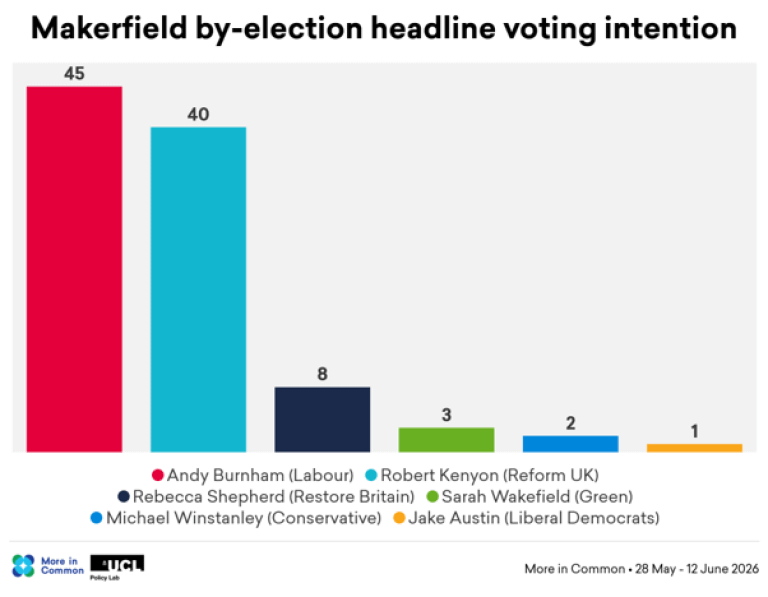
The race in Makerfield is likely to be tight. Polling by the UCL Policy Lab and More in Common finds that Andy Burnham is only narrowly leading ahead of Reform’s Robert Kenyon. Marc Stears, director of the UCL Policy Lab, interprets these findings:
This election is being shaped by voters’ desire to find politicians who respect them and attend to their concerns. Both Burnham and Kenyon seek to embody this in different ways. Our poll shows a close race but what looks like it could pull Burnham over the line is that he’s seen as different to other politicians and seen as able to restore that respect. These are lessons whoever wants to lead the country must heed rather than immediately dive back into SW1 business as usual.
This week in HopeWorks: A Progressive Reader #5, we’re trying to understand what the by-election means for the country, how we can fund national defence, and much else.
What’s at stake?
It has been difficult to pinpoint Andy Burnham’s vision for Britain. Michael Jacobs’ piece in the New Statesman offers an interesting perspective:
Andy Burnham’s Manchesterism – as so far articulated – is primarily an attempt to get to grips with rentierism, in the form created by privatisation. Burnham argues that in sectors such as local transport, rail, housing, energy, water and social care, public control (which may but does not necessarily mean public ownership) can ensure that private providers are not creaming off excessive profits while under-investing in productive assets and charging high prices. He notes that, by keeping prices down in these sectors, governments could not only help hard-pressed consumers, but thereby reduce the measured rate of inflation, which would take pressure off the Bank of England and help keep interest rates down. Moreover, he argues, cutting such prices would reduce the degree to which the state has to pay housing and other benefits to help families make ends meet. In this way he makes a politically innovative – and surely attractive – link between capping the profits made by privatised providers and reducing both the cost of living and the cost of the welfare state.
Meanwhile, writing in the Financial Times, Wes Streeting laid out his growth-for-all vision for progressive capitalism:
Social democracy is as much about a successful market economy as it is about an active state. When Labour forgets the first part of that sentence, we and the country lose. We’ve got to be as focused on wealth creation as we are on wealth distribution. Growth and fairness aren’t in competition. Growth is the only way we can tackle Britain’s class, regional and generational inequalities.
Anyone can make the pro-growth choice when there are no downsides. This country needs a government unafraid of taking on vested interests and doing controversial things in the national interest. Donald Trump’s message to world-leading scientists and engineers is: you’re not welcome here. We should welcome them with open arms. We need a global talent programme to attract 20,000 of the world’s best and brightest over the next three years. Voters concerned with high migration aren’t so worried about tomorrow’s Nobel Prize winners discovering the future here in Britain.
(Why) did Manchester grow?
Writing in Notes on Growth, Michael Hill makes sense of the messy data on regional growth around the UK:
Greater Manchester is not Britain’s top-performing city region. Bristol, and particularly Edinburgh, have consistently outperformed it in recent decades. However, the broader claim that Greater Manchester has not outperformed most other British cities on a per capita basis is probably wrong, and tends to rest on an overly narrow reading of the data. Taking the evidence as a whole, Greater Manchester is one of the stronger performers, though the data is messy. If Greater Manchester’s population growth is allowed to count in its favour, as it should be, then its status as one of the strongest city-region performers after Edinburgh and Bristol becomes much clearer.
He also draws some relevant lessons for the rest of Britain:
Better roads and better public transport can help by making a wider labour market function more like one place. But the simplest and most powerful way to achieve this is still to allow lots of people to live and work close together. This is why the centres of big cities have made a comeback across the developed world. Greater Manchester’s strategy of building lots of homes in and around the centre of the conurbation is not a weird fixation of its leaders. It is going with the grain of the global economy. And it has worked.
Europe calling?
Equally important on the election coverage has been the issue of Europe. Writing in The New World, Matt Withers argues that, at least in Makerfield, the public is more pro-European than it used to be:
While much of the coverage of the election – which could see Andy Burnham returned to Westminster to push for the Labour leadership – has focused on the seat’s 64% vote for Leave in the 2016 referendum, fresh polling shows that only 34% now describe themselves as happy with the decision.
The findings suggest that the supposed risk for a progressive politician such as Burnham in criticising Brexit and proposing close EU links is much less than had been supposed.
Pollsters Opinium, on behalf of pro-PR campaign group Forward Democracy, asked voters in Makerfield, “To what extent, if at all, are you happy that the UK left the EU?”- a more sophisticated question than the usual “Do you think Brexit has gone well?”, which enables those happy that the UK left the EU to criticise the terms of Brexit.
In the event, only a third of voters – 34% – described themselves as ‘happy’, with 24% neither happy nor unhappy, 15% “somewhat” unhappy and 23% very unhappy.
The split between those voting for Burnham and Reform candidate Robert Kenyon was also noteworthy. Of Leave voters who were happy with Brexit, Burnham’s vote share was only 22%, but that doubled to 42% among those who were not happy (neither happy or unhappy, or any degree of unhappy), at the expense of both Reform and Restore Britain candidates.
Guns versus butter?
Meanwhile, Healey's resignation has forced back into focus the question of funding national defence. Ruth Curtice of the Resolution Foundation argues the dominant framing, defence versus working-age welfare, misses the point. The peace dividend funded the NHS and pensions, not benefits, and that's where the real trade-off now sits:
This issue is often distilled into a debate over ‘defence versus welfare spending’, which is an unhelpful oversimplification that people often misunderstand. That misunderstanding isn’t helped when the BBC publishes charts […] saying that “defence spending has fallen as welfare spending has risen”. It didn’t look quite right to me, so we took a closer look. […]
Going back to the original BBC article, while the chart is clearly wrong, you can still say that defence spending has fallen while welfare has risen – as long as you're clear what you mean by welfare. Many people regard health and education as part of the welfare state, and the services they provide are classified as 'benefits-in-kind' by the ONS. But let's face it, that's not what politicians mean when they call for welfare to be cut to fund defence. […] But if the public debate was about, for example, how to cut the health budget or pensions to pay for higher defence, perhaps it would be clearer what the real political trade-offs are, and why our politics is not facing up to them.
Polling by the Good Growth Foundation suggests a generalised concern about Britain’s defence:
Nearly half (46%) of the public say they are more worried about Britain’s defence and security than they were ten years ago. It is a concern that cuts across political divides and adds to the pessimism felt by many about the standing of their country. It is generally perceived that only the political right cares about our military might and takes patriotic pride in our armed forces. But, repeatedly in our focus groups, we heard dismay that Britain has been diminished from all sides. One Labour-Left Switcher bluntly told us they think the country is “weak”, a Labour-Reform Switcher argued “the UK itself is in a mess.” Concern about the country’s defence is not limited to one political view and overall opinion is remarkably similar to how people imagine our economy: fragile.
But when it comes to voters’ attitudes towards defence spending, the picture is more nuanced, the same polling shows:
Voters doubt the UK’s ability to act decisively and defend itself from malign forces in all forms. But, when defence is put in a straight fight with visible pressures “at home”, it loses. And this will remain the case unless people can see how defence spending helps to fix what feels broken in their lives.
Nearly half (46%) of Britons believe the Government should increase spending on defence, compared to just 16% who say it should spend less. Yet only 10% of voters rank defence and national security among the top three most important issues facing the country - far behind the economy and cost-of-living (63%), immigration and asylum (52%) and health and the NHS (45%). People are worried enough to back higher spending, but not enough to put defence ahead of the pressures they feel every day.
Food for thought
Free and Equal: What Would a Fair Society Look Like? by Daniel Chandler. In hectic times like these, it feels out of touch to read philosophy. But if we really do want to set out a vision for the progressive left, we better think as hard about what we want to achieve, as we think about what’s a popular and effective policy. Daniel Chandler’s book on Rawls’ political theory offers a refreshing perspective.
The pathologies of ‘Bristolism’: devolution and its failures in the West of England by Charlotte Sellers. The Greater Manchester area has been getting a lot of attention in the recent debates surrounding devolution. But ambitious reform should tackle the failures as much as it draws on success stories. Charlotte Sellers’s article in Renewal does this excellently.
Makerfield polls: Reform vs Burnham by Anoosh Chakelian and Ben Walker. Nervous about tomorrow’s by-election or want to bet on it? Look no further than this walkthrough of the polling in Makerfield.